


Los Gigantes, Playa de la Arena or Puerto de Santiago: which part of the west coast fits your rental strategy?
Three towns, two kilometres apart, sharing one stretch of the western Tenerife coast. On Booking.com they often show up under the same search. On Airbnb, guests barely distinguish between them. And yet — when you look at what actually happens inside each one, at the bookings, the guest mix, the styling that works, the pricing ceilings — they are three genuinely different rental markets.
Owners who are looking at the west coast tend to treat it as one decision. In practice, it's three, and the right answer depends almost entirely on what kind of owner you want to be.
We manage properties across this stretch of coast. We watch the booking calendars. We hear the guest feedback on check-out. We see the reviews roll in through the autumn and into high season. Here's how the three areas actually compare, side by side, with no punches pulled.
Puerto de Santiago: the steady workhorse
Puerto de Santiago is the oldest of the three. It's been a working Canarian town longer than the tourist infrastructure around it has existed, and it still feels like one — a proper supermarket, a primary school, a vet, the kind of slightly overgrown front garden you won't find in El Duque. This is not a criticism. For a certain kind of guest, it's the whole point.
The rental market here skews toward returning guests. Not in the weak sense ("they came back once") but in the properly loyal sense — couples in their sixties booking the same apartment for the same three weeks in January for the fifth year running. A large portion of Puerto de Santiago bookings are direct rebookings or referrals. Platform dependency is lower here than in almost any other South Tenerife area.
What performs
Two-bedroom apartments with a sea view, a real balcony, and walking access to Playa de la Arena. Ground-floor units with terraces for guests who don't love stairs. The older urbanisations — some of them renovated tastefully over the last five years — can outperform newer builds because the locations are better and the comunidades are more settled. Winter is the gold season here; a well-run Puerto de Santiago property often hits 95%+ occupancy between November and March.
What doesn't
Luxury positioning without a view. Puerto de Santiago's guest is not paying a premium for marble countertops if the balcony looks at another balcony. The guest is here for the quiet, the predictability, the familiar Spar at the end of the street. Premium pricing has to be earned through the view, the terrace, and the location — not the finish.
Who this suits
Owners who want steady, high-occupancy, low-drama returns. The rate ceiling is lower here than in Los Gigantes, but so is the volatility. If you want a property that quietly pays its own mortgage plus a healthy margin without dramatic peaks or troughs, Puerto de Santiago is a strong bet.
Playa de la Arena: the quiet overachiever
Playa de la Arena sits between Puerto de Santiago and Los Gigantes, built around one of the most photogenic black-sand beaches on the island. Administratively it's the same municipality as the other two — Santiago del Teide — but it has its own distinct feel: smaller, less built-up, more coastline than streetscape.
And then there's the Q-flag. In 2025, Playa de la Arena was awarded the Q for Tourism Quality — the Spanish tourism sector's equivalent of a Michelin star, awarded to destinations that meet exceptionally high standards of service, cleanliness, safety, and environmental management. It's a rare distinction. There are fewer than 20 beaches in the Canary Islands that hold it.
The practical effect has been visible on our booking calendars. Listings that mention the Q-flag in their description and photography convert at measurably higher rates than listings that don't. Guests are searching for it — or at least responding to it when they encounter it.
What performs
Apartments within a 3-minute walk of the beach with a clear sea-facing orientation. Small complexes with pools set back slightly from the seafront, where guests can walk to the water in the morning and retreat for an afternoon swim without driving. Anything with a terrace large enough for breakfast — Playa de la Arena guests are there for the long, slow mornings more than the evenings out.
What doesn't
Properties more than a few streets back from the beach — the whole reason guests choose Playa de la Arena over Puerto de Santiago or Los Gigantes is the beach itself. Lose proximity, and you lose the advantage. Also: apartments positioned as party-friendly or nightlife-adjacent. Wrong town. Guests here are here to sleep with the window open.
Who this suits
Owners who want the growth story. Playa de la Arena is, right now, the area along the west coast where guest perception is catching up with what locals have long known. The Q-flag is accelerating that. If you're buying with a 5-year horizon and want to ride rising recognition, this is where to look.
Los Gigantes: the premium anchor
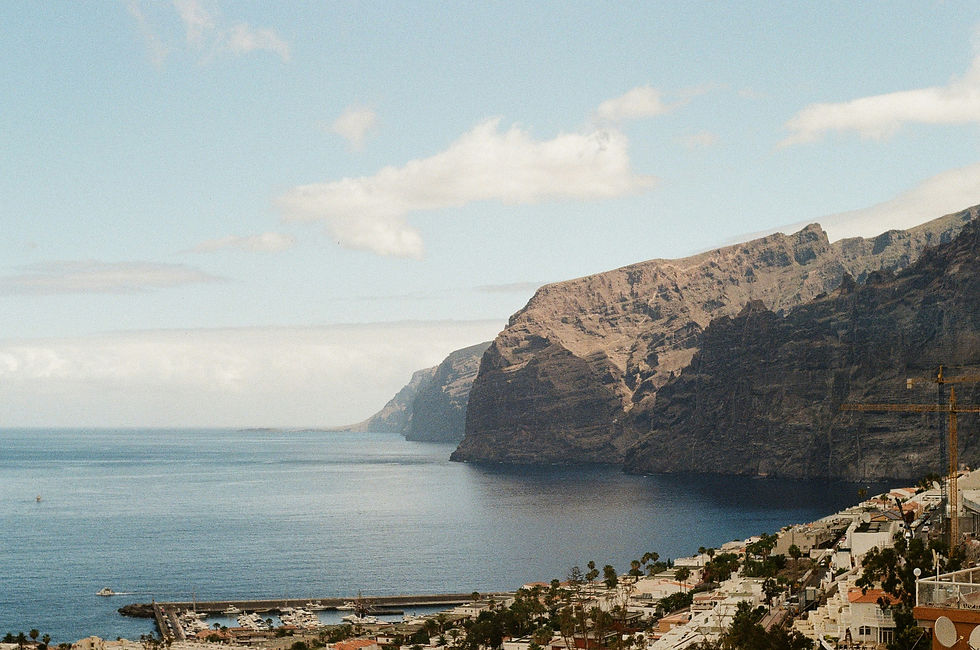
And then there's Los Gigantes. We'll try to stay objective because we live here, but the truth is that the geography itself does most of the work. A cliff wall that rises 600 metres straight out of the Atlantic, right at the edge of a compact town with a marina, a black-sand beach, and a handful of serious restaurants. Guests arriving for the first time often stop walking when they round the corner and see it properly. It's that kind of place.
The rental market here operates at a different tier from its neighbours. Nightly rates for cliff-view apartments in peak season are 30–50% higher than comparable units in Puerto de Santiago. The guest profile is more affluent, more international, and more willing to travel in shoulder season — which is worth gold for owners, because it flattens the booking curve and lifts annual yield.
What performs
Anything with a direct cliff view. This is not a small factor; it's the single biggest pricing determinant in the town. A one-bedroom apartment with a full cliff view will typically out-earn a three-bedroom apartment without one. After the view, the next price-setters are a private or semi-private pool, a proper terrace with sun exposure, and walking distance to the marina. Three-bedroom apartments and small villas are rare and in strong demand.
What doesn't
Apartments on the inland side of the town, facing the hills. These are perfectly pleasant places to live but they sell for less and rent for meaningfully less — guests coming to Los Gigantes are paying specifically for the drama of the view, and the market punishes properties that don't deliver it. Also, mid-tier properties with generic styling: the Los Gigantes guest is prepared to pay premium rates, but the corresponding expectation on quality is higher too.
Who this suits
Owners willing to buy quality and invest in styling. The upside in Los Gigantes is real, but it's extracted by owners who treat the property as a boutique operation rather than a generic short-term rental. The properties that quietly do 92%+ occupancy at premium rates are almost always the ones where someone has cared about the interior, the photography, the welcome, and the small details.

Side by side
Puerto de Santiago
Typical guest: returning Northern European couples, older demographic, long stays (10–21 nights)
Peak season: November to March
Nightly rate ceiling: moderate; premium earned through location, not styling
Occupancy pattern: flat, reliable, high direct-booking share
Strength: steady yield, low volatility
Playa de la Arena
Typical guest: mid-market families and couples, mixed-age, 7–14 nights
Peak season: year-round, with summer strength from mainland Spanish guests
Nightly rate ceiling: moderate-plus; rising with Q-flag recognition
Occupancy pattern: strong and broadening, beach-proximity driven
Strength: growth trajectory, broad seasonal appeal
Los Gigantes
Typical guest: international couples and small families, affluent, 7–10 nights
Peak season: year-round with strong shoulder seasons (April–June, September–October)
Nightly rate ceiling: highest of the three, anchored by cliff-view premium
Occupancy pattern: premium-weighted, quality-sensitive
Strength: highest nightly yield, premium positioning, boutique potential
The shared regulatory layer
All three towns sit within the same municipality: Santiago del Teide. That matters because municipal-level decisions under Ley 6/2025 — zoning, VV licensing thresholds, comunidad-level restrictions — apply to all three in the same framework, even if individual buildings and zones have different statuses.
The practical implication for owners: you cannot assume that because the apartment next door has a VV licence, yours is eligible. The zoning and comunidad checks are per-property, and the west coast has enough historical mixed-use and touristic zoning that surprises do happen, in both directions. Do the paperwork homework before the emotional commitment.
Santiago del Teide interprets Ley 6/2025 within a local framework that rewards thoroughness. A few hours with a specialist before you offer on a property is time that pays itself back many times over.
So how do you choose?
Here's the honest framework we'd apply if you were sitting across from us with a coffee.
If you want a property that pays its own way, quietly, with a predictable annual return and minimal operational drama — start in Puerto de Santiago. The returning-guest dynamic means the property almost books itself once it's been set up properly.
If you want to buy into a growth story, somewhere that's genuinely on the rise, where the Q-flag and the aesthetic of the area are starting to attract a higher calibre of guest — Playa de la Arena is where the interesting upside is right now. A well-chosen seafront property there is, in our view, one of the more underappreciated positions on the south-west coast.
If you want to run something genuinely premium — a boutique rental with a distinctive property, high-spec styling, a loyal high-spend guest base, and nightly rates that reflect it — Los Gigantes is where that operation thrives. The ceiling is higher but the execution has to match.
The thing these three towns have in common
What unites them — and what makes this stretch of coast genuinely one of the more interesting rental corridors in the Canary Islands — is that the guests who come here, to any of the three, tend to come back. The west coast has retention in a way the busier southern resort areas don't. Guests feel at home here. They write reviews mentioning the staff, the neighbours, the light, the walks. That translates directly into repeat bookings and referral traffic, which translates into easier occupancy and better yield for owners who run their properties well.
The flipside is that running a property well on this coast matters more than almost anywhere else. Not because it's harder, but because guests notice. The small details — the welcome note, the local restaurant recommendation, the fact that the handover happens smoothly at 10pm — feed the retention flywheel. Get it right and the property carries itself. Get it wrong and you're fighting the market.
If you're looking seriously at the west coast and trying to figure out which of the three suits your situation, come and have a talk with us. We'll walk through the specifics of what you're considering — the building, the view, the comunidad, the likely guest fit — and tell you honestly what we think. No sales pitch. Just the conversation we'd have with a friend who was asking.
Bart & Steffi
Hermosa Rentals


Comments